La Chinoise, dir. Jean-Luc Godard, France 1967, French with English subtitles, 96 min.
Contrary to what one might conclude based on the small number of films that Jean-Luc Godard completed based on plays and his occasional negative comments about theatre, he was in fact deeply interested in the artform and had numerous unrealised projects over the course of his career to write, stage and adapt plays, and to explore the theatrical process through cinema. Moreover, his engagement with theatre extended far beyond his dialogue with the work of Bertolt Brecht, to which it has often been reduced.
Godard’s discovery of theatre culture preceded that of cinema and went back to his theatre-going activities as a teenager in Paris in the post-war years. In the 1960s, once his filmmaking career had taken off, he developed plans for many unrealised films based on plays by playwrights as diverse as Alfred Jarry, Luigi Pirandello, Samuel Beckett, Sacha Guitry, Jean Giraudoux and Jean Racine. In particular, he had a long-running project to adapt Giraudoux’s Pour Lucrèce (Duel of Angels), a play in which he even acted at one point alongside Anna Karina under the directorship of their friend Antoine Bourseiller.
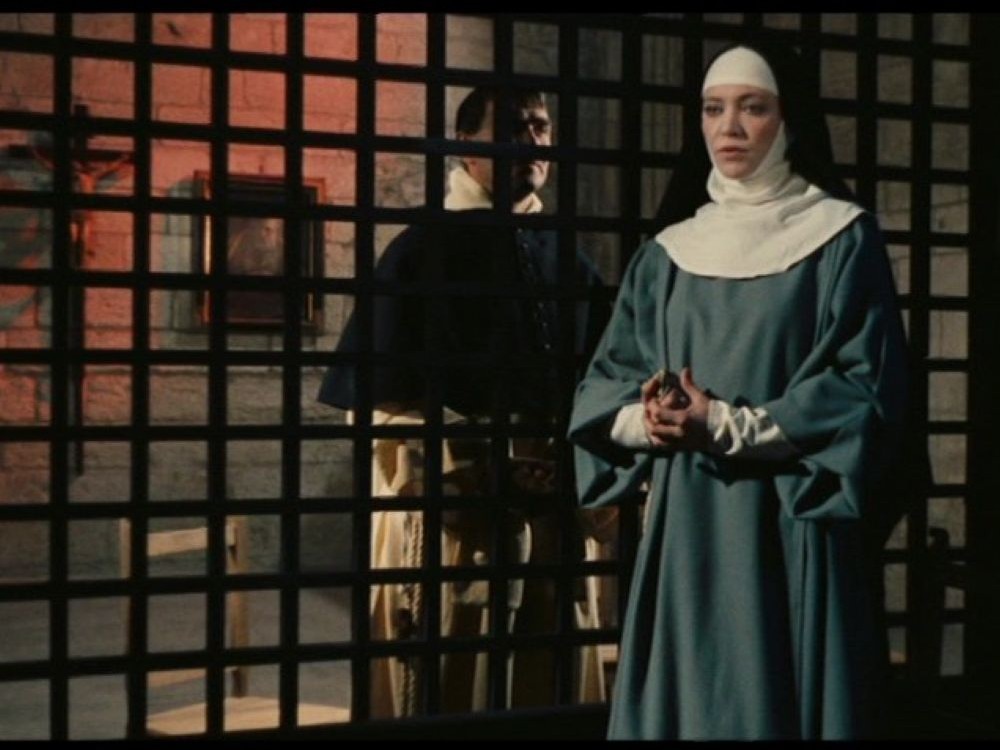
In 1962–63, Godard funded the staging of a play based on Denis Diderot’s novel La Religieuse (The Nun) at the Studio des Champs-Elysées theatre in Paris, directed by Jacques Rivette with Karina in the lead role. Rivette’s intention was to use this initiative as an opportunity to develop an exploratory sketch for the film he planned to make using the same script, which eventually appeared – following an initial ban and considerable controversy – as Suzanne Simonin, la Religieuse de Denis Diderot (The Nun, 1966), again with Karina in the title role.
Godard’s wide-ranging exploration of theatre in the 1960s culminated in La Chinoise (1967), a film that exemplifies his desire in this period to combine and blend theatrical and cinematic forms. ‘One should make theatre in the cinema’, as he put it, ‘mix things up’.* Although he had been nurturing the plans for the project that would take shape as La Chinoise from early in the decade, the final version was conceived, at least in part, to be included in the 1967 edition of the Avignon Theatre Festival and with a theatre-going audience in mind.
La Chinoise contains a barrage of references to dramatists and theatre directors, and a panoply of theatrical strategies and conventions embedded in its mise en scène and the actors’ performances. It concludes with three sketches depicting ‘door-to-door theatre’, ‘year zero theatre’, and ‘the first experience of theatre’, respectively (the latter two based on propositions by the prominent theatre director Roger Planchon, who had been instrumental in introducing Brecht’s ideas and work in France).
Programme
The Nun (Suzanne Simonin, la Religieuse de Denis Diderot), dir. Jacques Rivette, 1966, 134 min
La Chinoise, dir. Jean-Luc Godard, 1967, 96 min
This screening will be introduced by Michael Witt.
Godard’s discovery of theatre culture preceded that of cinema and went back to his theatre-going activities as a teenager in Paris in the post-war years. In the 1960s, once his filmmaking career had taken off, he developed plans for many unrealised films based on plays by playwrights as diverse as Alfred Jarry, Luigi Pirandello, Samuel Beckett, Sacha Guitry, Jean Giraudoux and Jean Racine. In particular, he had a long-running project to adapt Giraudoux’s Pour Lucrèce (Duel of Angels), a play in which he even acted at one point alongside Anna Karina under the directorship of their friend Antoine Bourseiller.
In 1962–63, Godard funded the staging of a play based on Denis Diderot’s novel La Religieuse (The Nun) at the Studio des Champs-Elysées theatre in Paris, directed by Jacques Rivette with Karina in the lead role. Rivette’s intention was to use this initiative as an opportunity to develop an exploratory sketch for the film he planned to make using the same script, which eventually appeared – following an initial ban and considerable controversy – as Suzanne Simonin, la Religieuse de Denis Diderot (The Nun, 1966), again with Karina in the title role.
Godard’s wide-ranging exploration of theatre in the 1960s culminated in La Chinoise (1967), a film that exemplifies his desire in this period to combine and blend theatrical and cinematic forms. ‘One should make theatre in the cinema’, as he put it, ‘mix things up’.* Although he had been nurturing the plans for the project that would take shape as La Chinoise from early in the decade, the final version was conceived, at least in part, to be included in the 1967 edition of the Avignon Theatre Festival and with a theatre-going audience in mind.
La Chinoise contains a barrage of references to dramatists and theatre directors, and a panoply of theatrical strategies and conventions embedded in its mise en scène and the actors’ performances. It concludes with three sketches depicting ‘door-to-door theatre’, ‘year zero theatre’, and ‘the first experience of theatre’, respectively (the latter two based on propositions by the prominent theatre director Roger Planchon, who had been instrumental in introducing Brecht’s ideas and work in France).
Programme
The Nun (Suzanne Simonin, la Religieuse de Denis Diderot), dir. Jacques Rivette, 1966, 134 min
La Chinoise, dir. Jean-Luc Godard, 1967, 96 min
This screening will be introduced by Michael Witt.
*‘Lutter sur deux fronts: Conversation avec Jean-Luc Godard’, Cahiers du cinéma, No.194, October 1967, p. 68.
01:30 pm
Sun, 11 Jan 2026
Cinema 1
Ticket information
- All tickets that do not require ID (full price, disabled, income support) can be printed at home or stored in email
- For aged-based concession tickets (under 25, student) please bring relevant ID to collect at the front desk before the event.
Access information
Cinema 1
- Both our Cinemas have step free access from The Mall and are accessible by ramp
- We have 1 wheelchair allocated space with a seat for a companion
- All seats are hard back, have a crushed velvet feel and they do not recline
- These are our seat size dimensions: W 42 x D 45 x H 52
- Arm rest either side of the seat dimensions: L 27 x W 7 x H 20
for the following requirements:
- We have unassigned seating. If you require a specific seat, please reserve this in advance
- Free for visitors where ticket prices are a barrier, please email


All films are ad-free and 18+ unless otherwise stated, and start with a 10 min. curated selection of trailers.
Members+ and all Patrons gain free entry to all cinema screenings, exhibitions, talks, and more.
Join today as a Member+ for £25/month.