Someone Moving dir. John Smith, UK 1973, 5 mins
As a form of live multimedia performance revolving around projected light, the light show is by nature ephemeral. These one-off events are dependent on chance encounters: between inks, dyes and other substances; a mobile audience, and various modes of performance – from music, theatre or dance to the real-time projection of film loops and other still and moving-image formats. As a result, light shows are often filmed to document a transient practice as well as generate new imagery that can be remixed and cast back into films, happenings, and future performances.
This programme opens with a selection of glass slide transparencies made in the late 1940s by the American painter and experimental film pioneer Sara Kathryn Arledge. Because glass is fragile and projectors heavy to lug around, Arledge later made several 16mm films from her hand-painted slides, which she called her “stabiles.” But not all of the works in this program are documents of performances or attempt to translate the live event onto film and video. The gloopy, amoebic forms of the liquid light show make their way into psychedelic intertitles, become the source material for vivid video effects, or are layered and superimposed to create abstract art works for multiple-projection environments at rock festivals, intermedia nightclubs, and arts labs.
Curated by Sophia Satchell-Baeza, this programme focuses on British and North American work from the 1960s and 1970s, bringing together early films by Barbara Hammer, John Smith, Jud Yalkut, Jerry Abrams, Scott Bartlett, and Mark Boyle and Joan Hills. Many of these artists merged film into their light shows, turned their light shows into films, or saw their work as part of a wider lineage of abstract and expanded cinema. Whether experimenting with colour theory or exploring free love and visionary perception, the films engage with strategies of sensory immersion and celebrate spontaneity and play. The evanescent practice of light projection is here revived and reanimated for the present.
With an introduction by Sophia Satchell-Baeza. Followed by a panel discussion with Jarvis Cocker and John Smith.
Programme
A Selection of Glass Slide Transparencies dir. Sara Kathryn Arledge, USA 2019, 10 mins
A selection of shimmering, hand-painted glass slide transparencies by the American painter and experimental filmmaker Sara Kathryn Arledge. Made between 1947 and 1950 while Arledge was teaching at California College of Arts and Crafts, they were created by melting colour gels onto glass and manipulating the material with various tools like toothpicks, toilet roll, and Sharpie pens.
O What A Lovely Whore dir. Mark Boyle, UK 1965, 5 mins
Performance documentation of an event staged by British artists Mark Boyle and Joan Hills – but activated, and even filmed, by a participatory audience – at the Institute of Contemporary Arts on 11 May 1965. “There are patterns that form continuously and dissolve; and these are not just patterns of line shape colour texture, but patterns of experience, pain, laughter” (Mark Boyle)
Chromoprobe dir. Mark Boyle/Sensual Laboratory, UK 1967, 5 mins
An abstract light show film made by The Sensual Laboratory, with music by Soft Machine.
D.M.T. dir. Jud Yalkut, USA 1966, 3 mins, 16mm
Jud Yalkut translates onto film a hallucinatory multimedia presentation by slide artists Jackie Cassen and Rudi Stern, who were then associates of psychedelic guru Timothy Leary. D.M.T. features Cassen and Stern’s graphic slides alongside choreography by modern dancer Mary McKay. Merging Bach with the Beatles, the score includes the backmasked voice of Ralph Metzner reading Leary’s Psychedelic Prayers.
Be-In dir. Jerry Abrams, USA 1967, 7 mins, 16mm
“Captures the spirit and essence of the great San Francisco Human Be-In of January 14, 1967. 10,000 people imbued with peace, love and euphoria. Set to hard rock as only San Francisco blues can produce. Be-In contains Allen Ginsberg, Lawrence Ferlinghetti, Timothy Leary, Malcolm McClure, Lenore Kandel and Buddha.” (Jerry Abrams)
Eyetoon dir. Jerry Abrams, USA 1968, 8 mins, 16mm
Before entering the pornography industry, Jerry Abrams made a series of colourful, frenetic, and sexually-charged experimental shorts. A founding member of the Bay Area liquid light show Head Lights, Abrams often incorporated light projections into his arsenal of psychedelic cinematic effects. Eyetoon is a colourful, lysergic celebration of free love and oceanic consciousness.
OffOn dir. Scott Bartlett, USA 1968, 9 mins, 16mm
A pioneering work of avant-garde cinema, OffOn was one of the first films to completely merge film and video techniques. Scott Bartlett’s and Tom DeWitt’s black-and-white film loops, originally created for their light show Timecycle, and Glenn McKay’s rear-projected liquid-light visuals, are mixed through a video effects bank and re-photographed, with sections of the film strip hand-coloured using food dye. A pulsating eye becomes a redolent motif for expanded consciousness and visionary perception, as images dilate, dissipate and mirror themselves.
Contribution to Light dir. Barbara Hammer, USA 1968, 4 mins
“Contribution to Light is all about my excitement and thrill at seeing reflected and refracted light. I shot the edges of pieces of found broken glass that streamed light rays broken into myriad colours. I saw, years later, a shared aesthetic in Stan Brakhage’s study of a crystal ashtray.” (Barbara Hammer)
Aldebaran Sees dir. Barbara Hammer, USA 1969, 3 mins
“The world of Aldebaran is projected light, rear screened and filmed again, pre-optical printer, and contemporary with the Haight-Ashbury projection light shows that played behind the bands at The Fillmore.” (Barbara Hammer)
Triangles dir. John Smith, UK 1972, 3 mins
John Smith’s first 16mm film is an abstract animation made by superimposing and rephotographing two black-and-white film loops, punctuated with found footage from an educational science film and set to The Velvet Underground track, “White Light / White Heat”. The loops were originally used in Smith’s light show, where they were projected through a spinning disc of theatrical lighting gels in order to create the variations in colour that are recorded in the film.
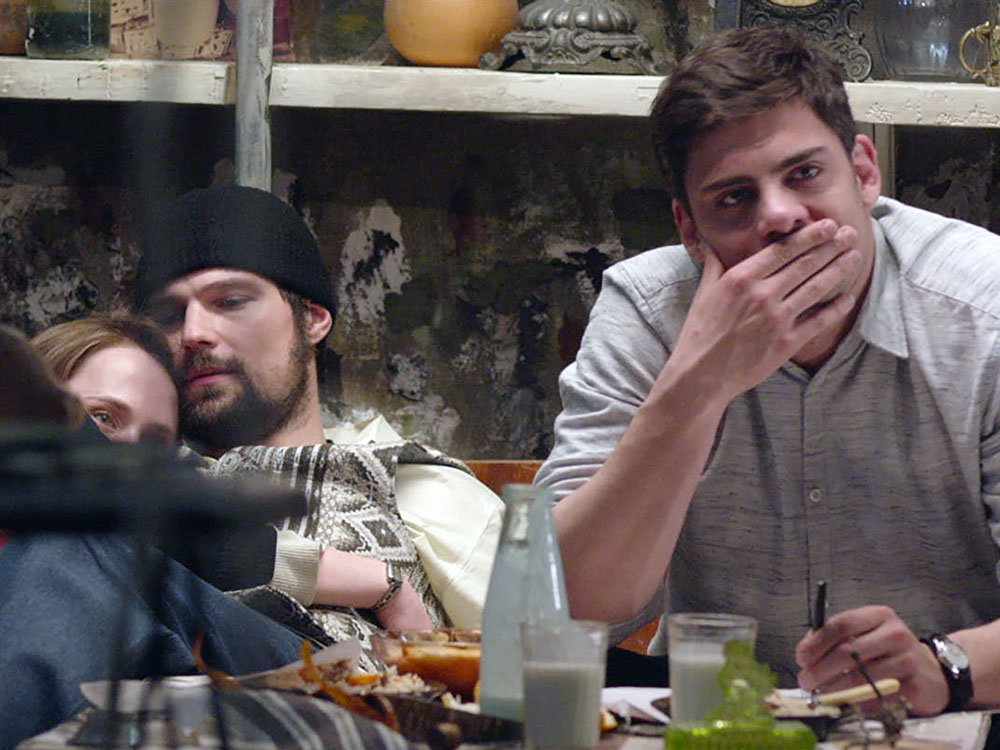
Someone Moving dir. John Smith, UK 1973, 5 mins
Someone Moving shows a figure in motion – artist Lis Rhodes – through various poses and colour schemes. Using source material shot on Super 8, Smith made high-contrast black-and-white 35mm transparencies from the individual film frames, which he projected using colour filters and rephotographed on 16mm, allowing him to play with different colour combinations and layers of imagery. The 35mm slides were also utilised in Smith’s light show. Someone Moving has an original soundtrack by avant-garde musician Peter Cusack.
Interior Garden II dir. Sara Kathryn Arledge, USA 1978, 8 mins
Sara Kathryn Arledge made several films in the 1970s and 1980s that translated her fragile, slide-projection performances into abstract cinema. She called these films her ‘stabiles.’ In Interior Garden II, nineteen glass slide transparencies in combinations of black, white, and sepia are brought to life in combination with the heightened sounds of birds twittering.
Making OffOn dir. Scott Bartlett and Cynthia Hagens, USA 1981, 10 mins
In 1980, Scott Bartlett recreated the making of OffOn for a video production class at UCLA. This primer on video techniques, made with the help of his students and Cynthia Hagens, transforms into a meditation on art-making, perception, and creative collaboration.
This programme opens with a selection of glass slide transparencies made in the late 1940s by the American painter and experimental film pioneer Sara Kathryn Arledge. Because glass is fragile and projectors heavy to lug around, Arledge later made several 16mm films from her hand-painted slides, which she called her “stabiles.” But not all of the works in this program are documents of performances or attempt to translate the live event onto film and video. The gloopy, amoebic forms of the liquid light show make their way into psychedelic intertitles, become the source material for vivid video effects, or are layered and superimposed to create abstract art works for multiple-projection environments at rock festivals, intermedia nightclubs, and arts labs.
Curated by Sophia Satchell-Baeza, this programme focuses on British and North American work from the 1960s and 1970s, bringing together early films by Barbara Hammer, John Smith, Jud Yalkut, Jerry Abrams, Scott Bartlett, and Mark Boyle and Joan Hills. Many of these artists merged film into their light shows, turned their light shows into films, or saw their work as part of a wider lineage of abstract and expanded cinema. Whether experimenting with colour theory or exploring free love and visionary perception, the films engage with strategies of sensory immersion and celebrate spontaneity and play. The evanescent practice of light projection is here revived and reanimated for the present.
With an introduction by Sophia Satchell-Baeza. Followed by a panel discussion with Jarvis Cocker and John Smith.
Programme
A Selection of Glass Slide Transparencies dir. Sara Kathryn Arledge, USA 2019, 10 mins
A selection of shimmering, hand-painted glass slide transparencies by the American painter and experimental filmmaker Sara Kathryn Arledge. Made between 1947 and 1950 while Arledge was teaching at California College of Arts and Crafts, they were created by melting colour gels onto glass and manipulating the material with various tools like toothpicks, toilet roll, and Sharpie pens.
O What A Lovely Whore dir. Mark Boyle, UK 1965, 5 mins
Performance documentation of an event staged by British artists Mark Boyle and Joan Hills – but activated, and even filmed, by a participatory audience – at the Institute of Contemporary Arts on 11 May 1965. “There are patterns that form continuously and dissolve; and these are not just patterns of line shape colour texture, but patterns of experience, pain, laughter” (Mark Boyle)
Chromoprobe dir. Mark Boyle/Sensual Laboratory, UK 1967, 5 mins
An abstract light show film made by The Sensual Laboratory, with music by Soft Machine.
D.M.T. dir. Jud Yalkut, USA 1966, 3 mins, 16mm
Jud Yalkut translates onto film a hallucinatory multimedia presentation by slide artists Jackie Cassen and Rudi Stern, who were then associates of psychedelic guru Timothy Leary. D.M.T. features Cassen and Stern’s graphic slides alongside choreography by modern dancer Mary McKay. Merging Bach with the Beatles, the score includes the backmasked voice of Ralph Metzner reading Leary’s Psychedelic Prayers.
Be-In dir. Jerry Abrams, USA 1967, 7 mins, 16mm
“Captures the spirit and essence of the great San Francisco Human Be-In of January 14, 1967. 10,000 people imbued with peace, love and euphoria. Set to hard rock as only San Francisco blues can produce. Be-In contains Allen Ginsberg, Lawrence Ferlinghetti, Timothy Leary, Malcolm McClure, Lenore Kandel and Buddha.” (Jerry Abrams)
Eyetoon dir. Jerry Abrams, USA 1968, 8 mins, 16mm
Before entering the pornography industry, Jerry Abrams made a series of colourful, frenetic, and sexually-charged experimental shorts. A founding member of the Bay Area liquid light show Head Lights, Abrams often incorporated light projections into his arsenal of psychedelic cinematic effects. Eyetoon is a colourful, lysergic celebration of free love and oceanic consciousness.
OffOn dir. Scott Bartlett, USA 1968, 9 mins, 16mm
A pioneering work of avant-garde cinema, OffOn was one of the first films to completely merge film and video techniques. Scott Bartlett’s and Tom DeWitt’s black-and-white film loops, originally created for their light show Timecycle, and Glenn McKay’s rear-projected liquid-light visuals, are mixed through a video effects bank and re-photographed, with sections of the film strip hand-coloured using food dye. A pulsating eye becomes a redolent motif for expanded consciousness and visionary perception, as images dilate, dissipate and mirror themselves.
Contribution to Light dir. Barbara Hammer, USA 1968, 4 mins
“Contribution to Light is all about my excitement and thrill at seeing reflected and refracted light. I shot the edges of pieces of found broken glass that streamed light rays broken into myriad colours. I saw, years later, a shared aesthetic in Stan Brakhage’s study of a crystal ashtray.” (Barbara Hammer)
Aldebaran Sees dir. Barbara Hammer, USA 1969, 3 mins
“The world of Aldebaran is projected light, rear screened and filmed again, pre-optical printer, and contemporary with the Haight-Ashbury projection light shows that played behind the bands at The Fillmore.” (Barbara Hammer)
Triangles dir. John Smith, UK 1972, 3 mins
John Smith’s first 16mm film is an abstract animation made by superimposing and rephotographing two black-and-white film loops, punctuated with found footage from an educational science film and set to The Velvet Underground track, “White Light / White Heat”. The loops were originally used in Smith’s light show, where they were projected through a spinning disc of theatrical lighting gels in order to create the variations in colour that are recorded in the film.
Someone Moving dir. John Smith, UK 1973, 5 mins
Someone Moving shows a figure in motion – artist Lis Rhodes – through various poses and colour schemes. Using source material shot on Super 8, Smith made high-contrast black-and-white 35mm transparencies from the individual film frames, which he projected using colour filters and rephotographed on 16mm, allowing him to play with different colour combinations and layers of imagery. The 35mm slides were also utilised in Smith’s light show. Someone Moving has an original soundtrack by avant-garde musician Peter Cusack.
Interior Garden II dir. Sara Kathryn Arledge, USA 1978, 8 mins
Sara Kathryn Arledge made several films in the 1970s and 1980s that translated her fragile, slide-projection performances into abstract cinema. She called these films her ‘stabiles.’ In Interior Garden II, nineteen glass slide transparencies in combinations of black, white, and sepia are brought to life in combination with the heightened sounds of birds twittering.
Making OffOn dir. Scott Bartlett and Cynthia Hagens, USA 1981, 10 mins
In 1980, Scott Bartlett recreated the making of OffOn for a video production class at UCLA. This primer on video techniques, made with the help of his students and Cynthia Hagens, transforms into a meditation on art-making, perception, and creative collaboration.
08:30 pm
Thu, 16 Apr 2026
Cinema 1
Ticket information
- All tickets that do not require ID (full price, disabled, income support) can be printed at home or stored in email
- For aged-based concession tickets (under 25, student) please bring relevant ID to collect at the front desk before the event.
Access information
Cinema 1
- Both our Cinemas have step free access from The Mall and are accessible by ramp
- We have 1 wheelchair allocated space with a seat for a companion
- All seats are hard back, have a crushed velvet feel and they do not recline
- These are our seat size dimensions: W 42 x D 45 x H 52
- Arm rest either side of the seat dimensions: L 27 x W 7 x H 20
for the following requirements:
- We have unassigned seating. If you require a specific seat, please reserve this in advance
- Free for visitors where ticket prices are a barrier, please email
All films are ad-free and 18+ unless otherwise stated, and start with a 10 min. curated selection of trailers.
Members+ and all Patrons gain free entry to all cinema screenings, exhibitions, talks, and more.
Join today as a Member+ for £25/month.